Are you trying to decide between GoodDay and Infinity?
GoodDay is a comprehensive work management platform with more built-in features like time tracking, goals, and multiple project views, while Infinity is known for its database-style flexibility and highly customizable structure.
| GoodDay | Infinity | |
| Core functionality | End-to-end work management with advanced planning and execution tools. | Flexible database and task organization based on a custom folder structure. |
| Advanced features | Native time tracking, resource management, and detailed analytics. | Custom attributes, formulas, and deep data filtering. |
| Visuals | Professional, data-rich interface with over 20 professional views. | Clean, colorful interface with a focus on custom labels and icons. |
| Complexity | Robust but logic-driven for quick professional adoption. | High initial setup time to build custom structures from scratch. |
| Best for | Teams need a high-performance system for all work processes. | Individuals or teams wanting a modular, DIY organization system. |
| Choose if | You want all professional tools in one place without hidden costs. | You prefer a highly manual, database-driven organization style. |
In this guide, we’ll explore every factor to consider when choosing between GoodDay and Infinity to help you select the best project management software.
But if you have any questions that are not covered in this article, you can always connect with our team via info@goodday.work
GoodDay vs Infinity: an overview
Choosing the right platform requires understanding whether you need a ready-to-use professional system or a flexible blank canvas. Both tools aim to improve productivity, but they serve different operational philosophies.
What is GoodDay?
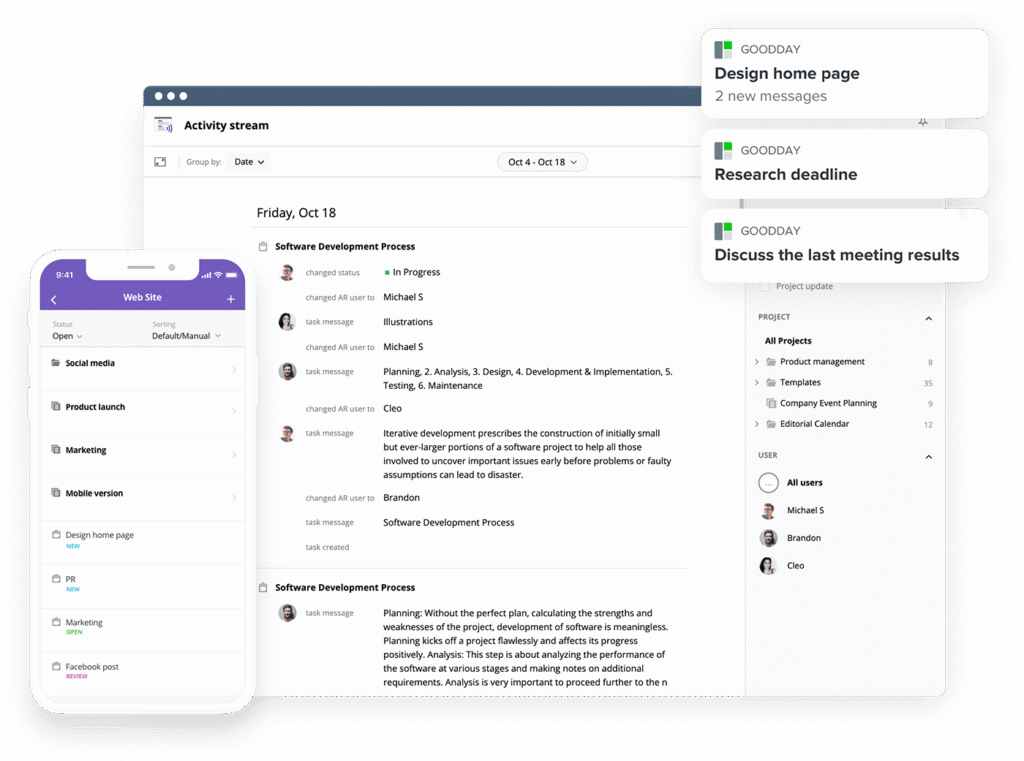
GoodDay is a versatile work management platform trusted by Fortune 500 companies and startups alike. It provides templates for various teams and supports methodologies like Agile and Scrum through advanced Gantt charts and Kanban views. Equipped with native time tracking, CRM, and elite security, it was recognized in 12 Capterra shortlists in 2026.
What is Infinity?
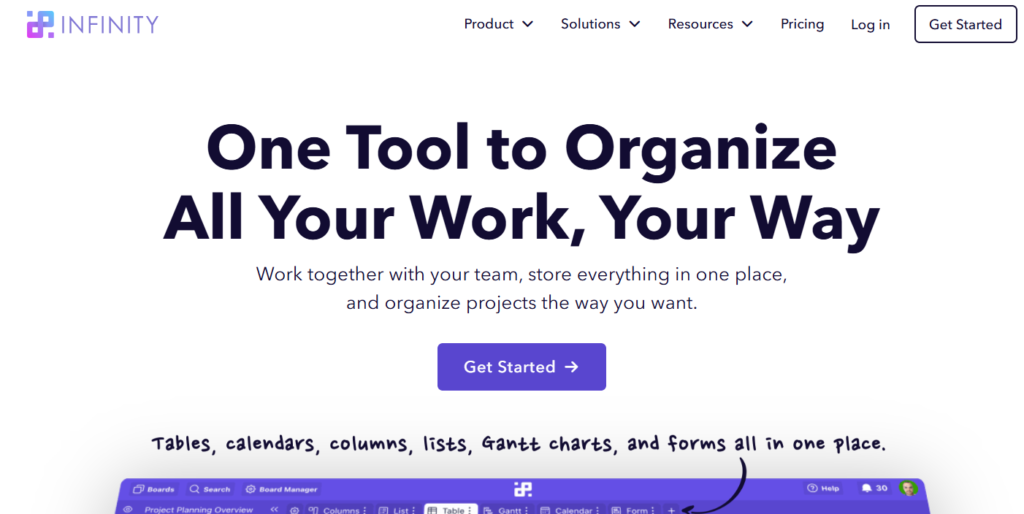
Infinity is a project management tool that emphasizes total flexibility through a database-like structure. It allows users to organize any type of data using a hierarchy of workspaces, folders, and items. While it offers multiple views, its primary strength lies in the ability to create custom attributes for highly specific organizational needs.
GoodDay vs Infinity: key differences
Understanding the foundational differences in pricing, support, and accessibility is the first step in finding the right software for your company. GoodDay generally provides more “out of the box” value for professional teams compared to the manual setup required in Infinity.
| GoodDay | Infinity | |
| Free Version | Yes (up to 15 users) | Limited trial or paid-only access |
| Starting Price | $4 user/month | $6 user/month |
| Support | Email, Help Desk, FAQs, Forum, Knowledge Base, Phone Support, 24/7 (Live Rep) | Email, Help Center, Chat |
| Ideal Team Size | Small, Medium, Large | Freelancers, Small, Medium |
| Supported devices | Desktop (Mac, Windows, Linux), Mobile (Android, iPhone) | Desktop (Mac, Windows), Mobile (Android, iPhone) |
| Training | Documentation, Live Online, In Person | Documentation, Video Tutorials |
| Integration capabilities | GoodDay offers a highly connected ecosystem with native support for Slack, Gmail, and the full Google Workspace lineup, including Calendar, Docs, and Drive. You can also easily link your storage and development workflows through Dropbox, Box.com, GitHub, and GitLab, all while maintaining secure access with SSO (SAML). For any specialized needs, the platform connects to more than 1,300 apps via Zapier or allows for bespoke development using its flexible API. | Infinity connects with basic tools like Slack and Google Drive, and uses Zapier for wider connections, but lacks the deep native integration depth for developer tools found in GoodDay. |
GoodDay vs Wrike: comparison of features
A side-by-side comparison of specific features reveals which platform offers more utility out of the box. GoodDay consistently provides advanced tools like time tracking and resource management across more of its plans.
| Feature | GoodDay | Infinity |
| Kanban Features | Yes | Yes |
| Collaboration Tools | Yes | Yes |
| Dependency Tracking | Yes | Yes |
| KPI Monitoring | Yes | No |
| Milestone Tracking | Yes | Yes |
| Multi-Board | Yes | Yes |
| Prioritization | Yes | Yes |
| Project Planning | Yes | Yes |
| Roadmapping | Yes | Yes |
| Supports Scrum | Yes | Yes |
| Task Management | Yes | Yes |
| Time Tracking | Yes | No (requires third-party) |
| Project Management Features | Yes | Yes |
| Agile Methodologies | Yes | Yes |
| Budget Management | Yes | No |
| Client Portal | Yes | No |
| Cost-to-Completion Tracking | Yes | No |
| Customizable Templates | Yes | Yes |
| Gantt Charts | Yes | Yes |
| Idea Management | Yes | Yes |
| Kanban Board | Yes | Yes |
| Portfolio Management | Yes | No |
| Resource Management | Yes | No |
| Time & Expense Tracking | Yes | No |
| Traditional Methodologies | Yes | Yes |
| Due Date Tracking | Yes | Yes |
| Progress Tracking | Yes | Yes |
| Template Management | Yes | Yes |
| Dashboard | Yes | Yes |
| Issue Management | Yes | Yes |
| Requirements Management | Yes | No |
| Status Tracking | Yes | Yes |
| Percent-Complete Tracking | Yes | Yes |
| Create Subtasks | Yes | Yes |
| Mobile Access | Yes | Yes |
| Recurring Tasks | Yes | Yes |
| Reporting / Analytics | Yes | No (basic only) |
| Spreadsheet View | Yes | Yes |
| Task Board View | Yes | Yes |
| Task Planning | Yes | Yes |
| Task Scheduling | Yes | Yes |
| Task Tracking | Yes | Yes |
| To-Do List View | Yes | Yes |
GoodDay vs Infinity: comparison of pricing
Pricing is a significant differentiator, particularly for organizations seeking long-term value. While one software uses a tiered seat-based model with several restrictions, the other focuses on accessibility and inclusion of advanced features.
GoodDay pricing
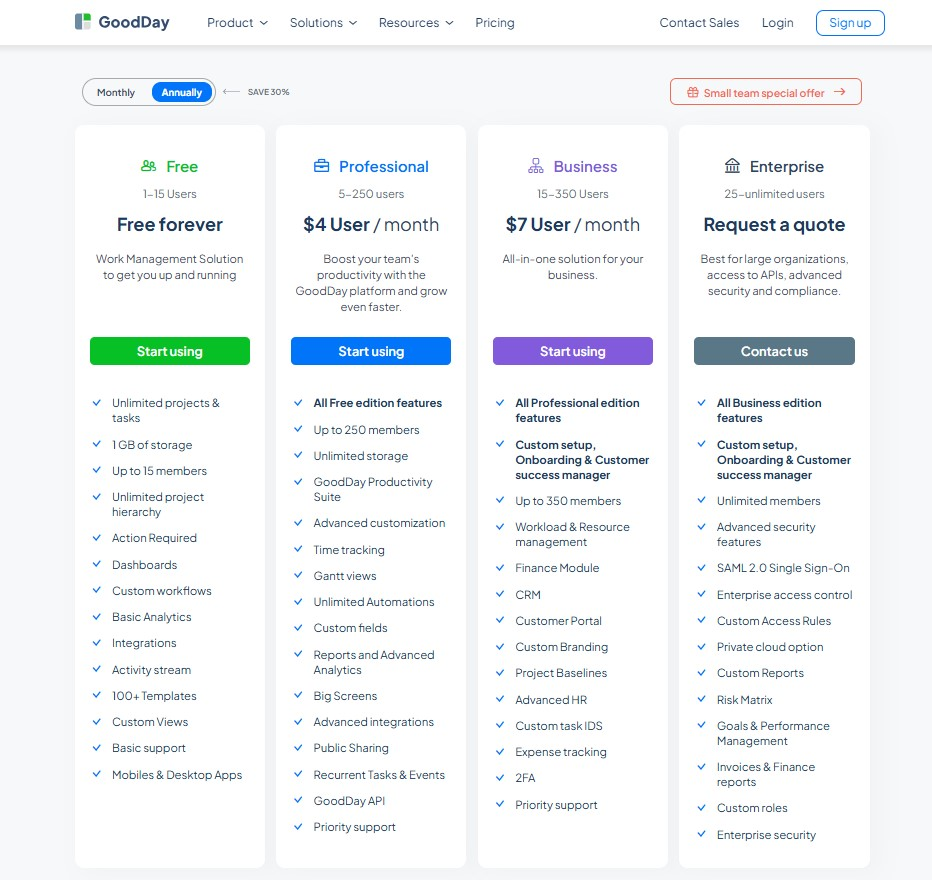
The pricing structure at GoodDay ensures teams get sophisticated tools, including Gantt charts, time monitoring, analytics, and resource planning, without the need for expensive bolt-ons. This approach makes GoodDay a more economical choice for organizations that require a full suite of project management tools as they scale.
- Free plan (up to 15 users): Offers unlimited tasks and projects, standard integrations and workflows, dashboards, various templates, and essential analytics.
- Professional plan ($4 per user/month): Includes everything in Free plus native time-tracking, Gantt views, unlimited data storage, advanced integrations, automation, and custom fields.
- Business plan ($7 per user/month): Adds CRM capabilities, a customer-facing portal, resource and finance tracking, and custom branding for growing organizations.
- Enterprise plan (custom pricing): Designed for large-scale operations with SSO, advanced security, private cloud options, and custom roles.
Infinity pricing
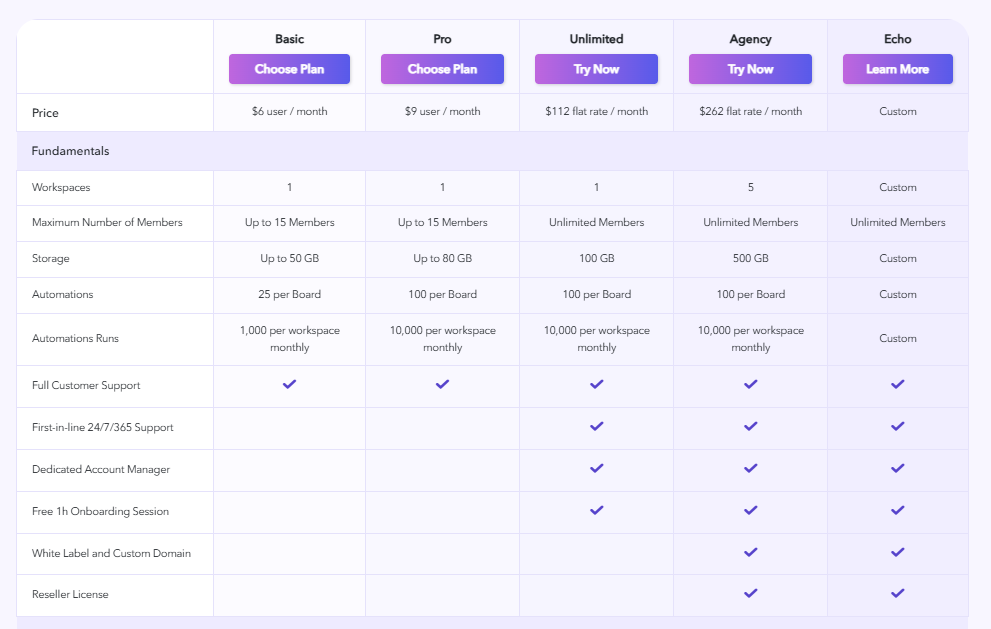
Infinity primarily relies on a tiered subscription model, often focusing on workspace limits and the number of members.
- Basic Plan ($6 per user/month): Includes core attributes and basic views like Table and List.
- Pro Plan ($9 per user/month): Unlocks Gantt charts, formulas, and more automation options.
- Unlimited Plan ($112 per month): Offered as a flat-fee monthly rate for larger teams who need unlimited members in a single workspace.
- Agency ($262 flat rate/month): Provides 5 workspaces.
GoodDay vs Infinity: pros and cons
Every software has its strengths and trade-offs. It is important to weigh the deep functionality of a platform against the effort required to maintain it.
GoodDay pros and cons
| Pros | Cons |
| Delivers robust built-in features and high operational flexibility. | Extensive options may feel complex for very simple task lists. |
| Highly cost-effective for teams as they scale their user count. | Initial configuration may take more thought due to deep features. |
| Provides an open API and broad native app integrations. | Learning the full breadth of the system requires a small time investment. |
| Exceptional support for professional project management methodologies. | Designed for focused work rather than social networking. |
Infinity pros and cons
| Pros | Cons |
| Extreme flexibility to build any data structure. | Requires manual building of almost every workflow. |
| Simple, colorful interface for visual organizers. | Lacks native time tracking and deep reporting. |
| Flat-rate pricing options for very large teams. | Performance can slow down with extremely large databases. |
GoodDay vs Monday.com: use cases by industry
Choosing the right project management tool depends heavily on whether your industry requires a feature-complete workspace or a modular “Work OS.” Here is how different sectors utilize these tools to manage their daily operations.
| Industry | GoodDay | Monday.com |
| Architects | Manages complex project phases and blueprint revisions with ease. | Visualizes design phases using colorful status columns. |
| Accounting | Tracks billable hours and financial deadlines accurately. | Records client statuses in a central database. |
| Builders | Coordinates site schedules and equipment logs through Gantt charts. | Assigns basic tasks to subcontractors on a mobile board. |
| Business analysts | Centralizes data modeling and project requirements in a wiki. | Tracks research tasks through simple progress bars. |
| Bloggers | Organizes editorial calendars and research using the My Work dashboard. | Groups content ideas into different color-coded folders. |
| Construction | Monitors critical path and resource allocation for large builds. | Uses simple lists to track daily site inspections. |
| Contractors | Automates client reporting and progress tracking for every contract. | Keeps a basic log of active client projects. |
| Consultants | Streamlines client communication through dedicated portals and reports. | Shares high-level boards with external stakeholders. |
| Creatives | Balances creative workflows with deadline-driven task scheduling. | Focuses on visual asset organization and feedback. |
| Developers | Syncs directly with GitHub and GitLab for seamless sprint tracking. | Uses boards to track general software bugs. |
| DevOps | Manages deployment pipelines and system maintenance tasks effectively. | Organizes infrastructure updates into simple columns. |
| Digital agencies | Handles multi-client workloads and resource planning in one view. | Uses automation to move tasks through a sales funnel. |
| Engineers | Tracks technical specifications and project milestones with precision. | Visualizes project timelines for engineering teams. |
| Electrical contractors | Schedules field technicians and tracks time spent on various jobs. | Lists daily work orders for different job sites. |
| Entrepreneurs | Scales from a solo operation to a full team with consistent tools. | Builds a custom dashboard for diverse business ideas. |
| Events | Maps out every logistical detail and vendor deadline on a timeline. | Uses a calendar view to track event dates. |
| Enterprise | Enforces security and manages large user hierarchies across departments. | Connects multiple departments through a modular interface. |
| Executive assistants | Organizes complex travel schedules and executive task priorities. | Tracks administrative to-do lists in a grid. |
| Education | Manages curriculum development and faculty project timelines. | Organizes student projects into different workspaces. |
| Freelancers | Tracks every billable minute and generates professional reports. | Creates a personal system for organizing client notes. |
| Film production | Coordinates shooting schedules and post-production milestones. | List equipment needs for different filming days. |
| Financial institutions | Maintains strict audit trails and project governance for compliance. | Tracks internal administrative projects on boards. |
| Graphic designers | Connects design tasks with time tracking and client feedback. | Organizes visual files in a gallery view. |
| Home builders | Tracks materials, budgets, and subcontractor schedules simultaneously. | Displays basic house-building progress to clients. |
| HR | Manages recruitment pipelines and employee onboarding workflows. | Tracks candidate statuses in a simple spreadsheet. |
| Interior designers | Coordinates vendor deliveries and installation timelines. | Collects mood board inspiration in one place. |
| IT projects | Handles complex hardware rollouts and software implementation cycles. | Tracks help desk tickets through a basic workflow. |
| Large companies | Standardizes work processes across thousands of global users. | Customizes different “apps” for specific team needs. |
| Manufacturing | Manages production schedules and supply chain task dependencies. | List inventory updates in a table format. |
| Marketing | Plans multi-channel campaigns with integrated time and resource tools. | Uses colorful boards for creative brainstorming sessions. |
| Nonprofits | Tracks grant applications and volunteer coordination efficiently. | Organizes fundraising event tasks in a simple list. |
| Photographers | Schedules shoots and manages the editing process for every client. | Keeps a list of upcoming photography sessions. |
| Pharmaceutical industry | Oversees clinical trial stages and strict regulatory documentation. | Tracks research tasks across different lab teams. |
| Real estate | Manages property listings and closing processes in a structured way. | Tracks lead statuses in a visual sales board. |
| Research | Organizes complex data sets and academic project milestones. | Uses folders to categorize different research papers. |
| Small business | Provides all necessary tools in one affordable package. | Builds a simple custom system for general tasks. |
| Startups | Enables rapid scaling with professional project management foundations. | Experiments with different organizational styles easily. |
| Solopreneurs | Consolidates all business activities into a single productive hub. | Creates a highly personalized digital planner. |
| Tech companies | Drives product roadmaps and technical debt management. | Manages high-level team updates and social syncs. |
| Writers | Plans chapters, tracks word counts, and manages publishing dates. | Keeps a repository of various story ideas. |
| YouTubers | Coordinates scriptwriting, filming, and editing schedules in one view. | Tracks video production status from idea to upload. |
So, which project management software is better: GoodDay or Infinity?
There’s no absolute best. The answer depends on what you need for your business.
GoodDay is the stronger choice for teams that need a complete work management platform with built-in planning, time tracking, reporting, and support for complex projects. And Infinity is a good fit for individuals or small teams who want the freedom to build their own database from scratch.
You can dive in and try GoodDay for free to see how it fits your workflow.
And if you have any questions about selecting the right project management software for your business, you can always connect with our team via info@goodday.work
FAQs
What project management software is better, GoodDay or Infinity?
The better software depends on your need for native features versus manual customization. GoodDay is superior for teams that need built-in tools like Gantt charts and tracking time across multiple projects without buying extra apps. While Infinity offers a flexible interface for organizing ideas, GoodDay provides a more complete process for managing teams effectively. Professional managers often acknowledge that having everything in one place makes for a better work experience.
What is the most popular project management software?
The most popular software tools are those that provide high-level progress tracking and a reliable platform for collaboration. While tools like Infinity are known for their visual style, GoodDay is favored by those who focus on deep productivity and data. It helps a company maintain high standards without the need for constant app-switching.
Where can teams collaborate and manage projects in one place?
GoodDay is the ideal platform where teams can create tasks, share docs, and manage projects in a single, unified interface. It allows a project manager to oversee development and track progress across various workflows without limited functionality. You can organize your notes, chat with a person on your team, and track your time all within the same system. This level of integration is essential for modern business success and helps the team stay focused on the work that matters.
What is the best task management tool?
The best tool for managing tasks is one that offers both simplicity and power, such as GoodDay. It allows you to create subtasks, set recurring tasks, and view your work in several ways, including a list or a Gantt chart. Unlike some other tools, it does not have limited views on its professional plans, giving you the freedom to navigate your work your way. Whether you are managing small projects or a large company, it provides the tools you need to succeed.
What team collaboration tool brands are known for robust integration capabilities?
GoodDay is widely recognized for having some of the best integration capabilities in the world of project management. It can connect with major apps like Slack, Google Drive, and Gmail natively, and offers an API for custom connections. This allows for a seamless process where data flows between your favorite programs without manual entry. While Infinity and other tools use Zapier, GoodDay provides a more robust and direct integration experience for its users.
What team collaboration software has the best customization options?
GoodDay offers the best customization options because it allows you to adapt the interface and workflows to your specific business needs. You can create custom fields, roles, and project views to maintain a high level of organization across your team. While Infinity allows you to customize folders and attributes, GoodDay provides the professional logic needed to manage complex development projects. It gives you the power to organize work so that every person knows exactly what to do.
What team collaboration software has the best price?
GoodDay offers the best price for professional teams, starting at just $4 per user for its full set of features. This is significantly more affordable than many other tools that hide advanced features like Gantt charts behind higher pricing tiers. Even the free version of GoodDay is quite generous, allowing up to 15 users to manage projects together. It is a cost-effective choice for any company that wants to maximize its budget while gaining high-quality software.
What is the top software for managing teams and tracking time?
GoodDay is the top software for managing teams and tracking time because these features are built directly into the core platform. You can monitor the progress of various tasks and see exactly how much time is being spent on each project in real-time. This helps managers identify bottlenecks and improve the overall development process within the team. I hope you see how having these tools integrated leads to a more efficient and productive work environment.
What is the best software for a project manager to collaborate effectively?
For a project manager, GoodDay is the best software for effective collaboration because it provides a transparent view of all team activities. You can leave a comment on a task, share important docs, and review the status of multiple projects in a single dashboard. It eliminates the controversial problem of lost information by keeping all communication and files tied to the relevant work items. This ensures that everyone stays on the same page and that the project moves forward toward a successful sign-off.